
Ioniq EV Advantages Over Polestar 2

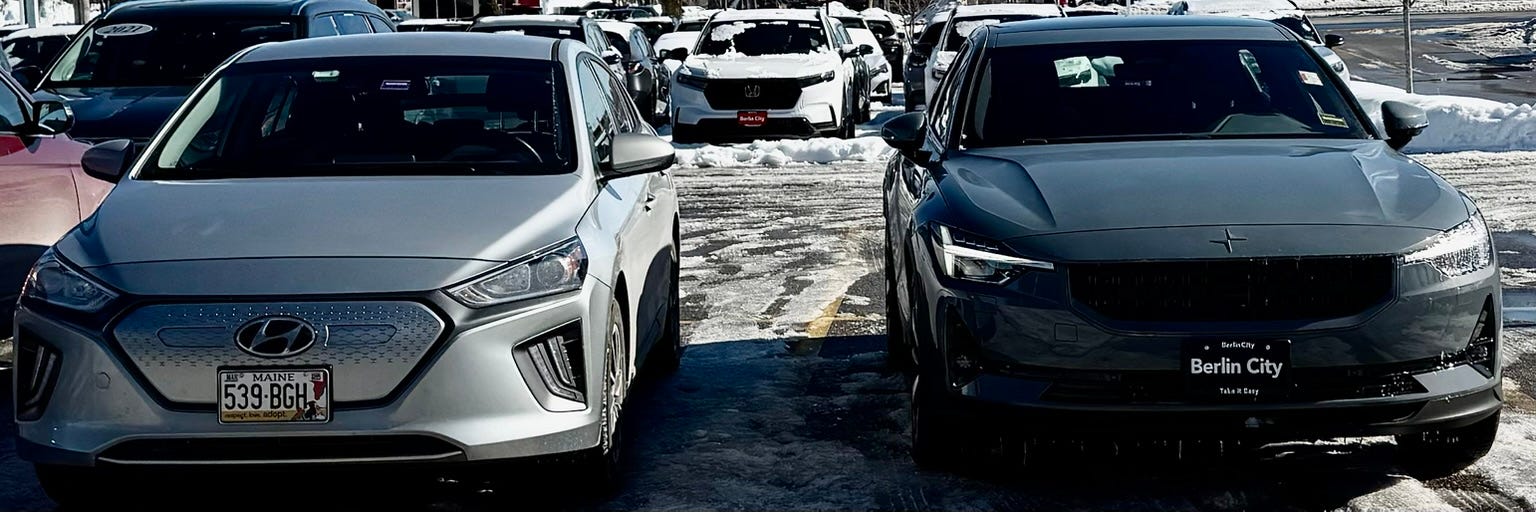
Before I got my Polestar 2 in April, I was driving an Ioniq EV. It was a nice little economy EV that, somewhat surprisingly, had several features that I wished were in my Polestar 2. Here’s a quick list of them.
Wireless CarPlay: This was always somewhat flaky, but it was certainly convenient. It did have a habit of draining the iPhone battery rather quickly if I forgot to plug in the phone, though. The Ioniq does have a wireless charging pad, but that rarely charged properly and usually just overheated my phone. In the end I mounted a MagSafe puck in the car and used that to keep the phone charged while it was connected to CarPlay. To be honest, I’m not sure I really miss this much in the Polestar 2. Wireless CarPlay is convenient, but I’d still have to plug my phone in to keep the battery from draining quickly as the wireless charge pad in my Polestar 2 also does not work with my iPhone 15. If I do decide I want wireless CarPlay, Ottocast makes some small adapters that can add it.
Utility mode: I never actually used this, but its purpose was to let you keep the car on for extended periods without it being in “drive” mode. I do find it annoying that there is no good way to keep my Polestar 2 on for more than 30 minutes at a time.
Tire Pressure Monitor System: The TPMS in the Ioniq would report the pressure of each tire. The Polestar 2 has a much simpler system that just reports a warning when it thinks pressures are off (by calculating rotation speeds of the wheels), but it never really knows the actual pressure and the warning can be shown even when the tires are at the correct pressure or won’t be shown if all the tires have low pressure.
Better cup/bottle holders: I generally didn’t use the center cupholders, but the door pocket cupholder worked well. I solved this with my Polestar 2 by purchasing some 3D-printed cupholders for the door pocket and using a shorter water bottle.
Insane efficiency: The Ioniq EV is the GOAT when it comes to EV efficiency. In the summer it could easily reach 6+ mi/kWh driving around town and 4+ on the highway. The Polestar 2 seems to peak around 3.2 mi/kWh on the highway and the best I’ve seen at all is around 4 mi/kWh.
Displays efficiency as mi/kWh: Speaking of efficiency, the Polestar 2 uses the objectively worse kWh / 100 miles measurement. I sure wish there was a preference to change that.
Separate max charge levels for AC and DC charging: The Polestar 2 only has a single max charge level that applies to both AC and DC charging. Not a big deal as it is easy enough to change, but I’d prefer to have 90% for AC and 80% for DC.
Of course, the Ioniq EV was otherwise a worse car. It was much slower, noisier and not nearly as much to drive. Its stereo was also pretty weak.
My Thoughts on the OG Hyunda Ioniq

As I wrote about in Accidentally Electric, my newly acquired electric vehicle is a 2021 Hyundai Ioniq electric. Going into this, I didn’t know much about this EV, but as more of them are showing up on the used market, I thought it might be worth providing some more insight about it.
Accidentally Electric

In early 2024 I decided we needed another car. We had too many drivers and not enough cars. Although I work from home and don’t frequently need a car, I was often left home without a car and it would sometimes make me feel like I was under house arrest! The times when I did need a car required a fair amount of car shuffling with me having to drop others…